

Beyond the notes: Music as a foundation for Life
How old were you when you started playing the piano, and why did you choose this instrument?
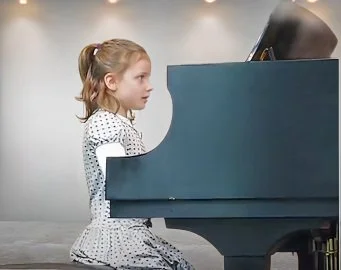
Myriam beginning piano, age 5.
My musical journey began very early, at the age of five, when my parents decided to enroll me in piano lessons. Neither of them was a musician, but my mother had seen an ad in the small Saint-Lambert newspaper promoting music initiation classes offered by a local teacher. Since we already had a good piano at home, the choice of instrument came naturally.
Looking back, I am very happy to have started with the piano. In my opinion, it provides a solid foundation for learning any other instrument, as it greatly facilitates the understanding of the fundamentals of music.
What has your musical journey been like?
Since I began piano at a young age, I gradually moved through the different stages of my musical training, completing Preparatory Levels 1 and 2, followed by Levels 1 to 8 of The Royal Conservatory of Music. Alongside these lessons, I attended Félix-Leclerc music elementary school, where I had the opportunity to explore several instruments: violin, clarinet, and flute, while also developing my singing practice. At that time, music held a central place in my daily life, with several hours of learning each week.
In high school, this commitment continued through my participation, for five years, in Secondaire en spectacle, where I performed various numbers combining voice and piano. I also joined my school orchestra as a violinist, where I discovered ensemble playing.
At the college level, I continued my path by completing a double DEC: one in classical music performance with a piano concentration at École Vincent-d’Indy, and another in social sciences at Collège Jean-de-Brébeuf. Finally, at the end of this journey, I had the opportunity to join CMM as a piano teacher, an experience I continue alongside my university studies.
What are some of your other interests?
Outside of music, my interests are quite varied. I have just completed my Bachelor of Laws at the Université de Montréal, a demanding program that occupied much of my time over the past three years. There, I discovered a field in which I can enthusiastically picture myself: a world that is both intellectually stimulating and rich in the diversity of its areas of practice.
I have also long had a passion for classical ballet, which I practiced diligently from the age of eight until very recently. This discipline has deeply shaped my journey, both through the rigour it requires and the artistic sensitivity it develops.
I also enjoy cooking, running, and visiting museums. I’m not too hard to please!
What place does music hold in your life?
At the moment, I spend almost my entire days surrounded by music, whether through performances, rehearsals, or deepening my understanding of it in theory classes. Music continues to inspire me every day, especially when I have the opportunity to work with artists whose fresh perspectives play an important role in my development.
What are some of your inspirations and future projects?
Music has played different roles in my life. It has taught me to listen differently, to recognize emotions without necessarily naming them, and to enter the world of composers whose works have stood the test of time. I was fortunate to be guided by passionate teachers, who passed on to me a refined understanding of this art, beyond simple execution. That said, practicing the piano was not always easy. There were more demanding periods, but each time, the pleasure eventually found its way back.
I In my daily life, music accompanies me almost everywhere: on my way to school, during workouts, with friends, or at concerts. It is a powerful and unifying art. It is easy to form connections around an artist or a song. Every Christmas, in my family, my sister and I take turns sitting at the piano to get everyone singing — even those who are slightly off-key — in a warm atmosphere filled with our favourite classics. These are precious moments made possible by our musical knowledge. There is something very enjoyable about being able to open an unfamiliar score, sight-read it, and share it with the people I love.
Since I began teaching three years ago, my relationship with music has taken on another dimension. Moving from the role of student to that of teacher has allowed me to see differently the things we eventually come to consider obvious after many years of practice. I have learned to identify the real challenges beginners face and to better understand their progress. I really enjoy seeing my students grow over the years, gain confidence, and discover how much music can contribute to self-confidence and a sense of accomplishment.
How does music help you in the field you are currently studying?
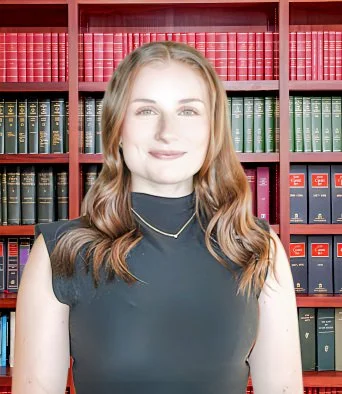
Myriam will begin her bar association exam in the fall.
Where to begin? Learning music gave me a true method for learning — a way of structuring my efforts that I now recognize in my study of law.
Piano practice is first built on a demanding technical foundation: precise fingering, coordination, and posture. But reducing music to that dimension alone would mean missing what is essential. Beyond technique, there is the interpretation and expression one wants to bring to each work. That is where the parallel with law becomes especially meaningful to me. As in music, one must first master the fundamentals: legislation, doctrine, major principles, and case law. But that is not enough. At a more advanced level, what makes the difference is the ability to understand nuances, grasp subtleties, and place each concept within a broader whole. A good musician does not simply play the right notes; they give meaning to the work. In the same way, a good jurist does not simply apply rules: they develop a global understanding of law and its interactions with society.
In both cases, mastery is made possible through attention to detail and rigour in one’s work. At a certain level, disciplines cease to be purely technical and become an art, each in its own field. Music combines a precise technical structure with great interpretive sensitivity; law, for its part, connects the study of texts and decisions with a broader understanding of their scope and impact.
Ultimately, the discipline, perseverance, and method developed through music are lasting skills, regardless of one’s field of study. Piano taught me rigour, resourcefulness, patience, and also the ability to recognize my limits and adapt the way I work.